Quick Answer: Working from home in a studio apartment comes down to three things: a defined work zone, a compact desk that fits your square footage, and clear boundaries between clock-on and clock-off hours. You don't need a spare room. You need a corner you can commit to and equipment sized for small-space living.
Small space, real job, no office door to close. That's the reality for millions of renters, and working from home in a studio apartment is completely doable once you stop fighting the square footage and start planning around it. This guide covers the layout choices and daily habits that actually move the needle, drawn from how residents set up remote work at Compass Flats and our studio and one-bedroom floor plans in New Braunfels, Texas.
Can You Really Work From Home in a Studio Apartment?
Yes. Plenty of people do it every day, and the data backs that up. Roughly 1 in 5 private-sector employees teleworked in early 2025, according to the U.S. Bureau of Labor Statistics, and studio renters make up a real slice of that group. The catch is separation: one room has to do two jobs without wrecking your focus.
Here's the upside of studio apartment living: less space means fewer places for clutter to pile up and a shorter walk between clocked-in and clocked-out. A small footprint forces the kind of discipline a spare room lets you avoid. Hybrid schedules are the most common setup for remote-capable jobs, so even a couple of work-from-home days a week need a spot that's ready to go.
How to Set Up an Apartment Home Office in a Studio
Claim one zone and defend it. Pick a corner, a stretch of wall, or the sliver beside a window, then anchor it with a desk and chair that stay put. A working apartment home office in a studio isn't about extra square footage. It's about one spot your brain ties to work.
Separation does the heavy lifting. Put your bed on one side and your desk on the other, and turn the desk to face a wall or window so the rest of the room falls out of view while you work. Renters don't need to drill anything to pull this off. A freestanding bookshelf or a tension-rod curtain can split a work zone from a sleep zone in an afternoon. An area rug under the desk and a small lamp can mark the boundary as clearly as any wall.
Essentials for a studio apartment workspace
You need less than the ads suggest. A few pieces do most of the work in a small setup:
- A compact desk and a chair that actually supports your back
- Reliable internet, ideally a wired connection for calls that can't drop
- Bright task lighting plus natural light, positioned to avoid screen glare
- Noise-canceling headphones for thin walls and shared buildings
- Vertical storage, so supplies climb the wall instead of eating your desk
Where to put your studio apartment desk
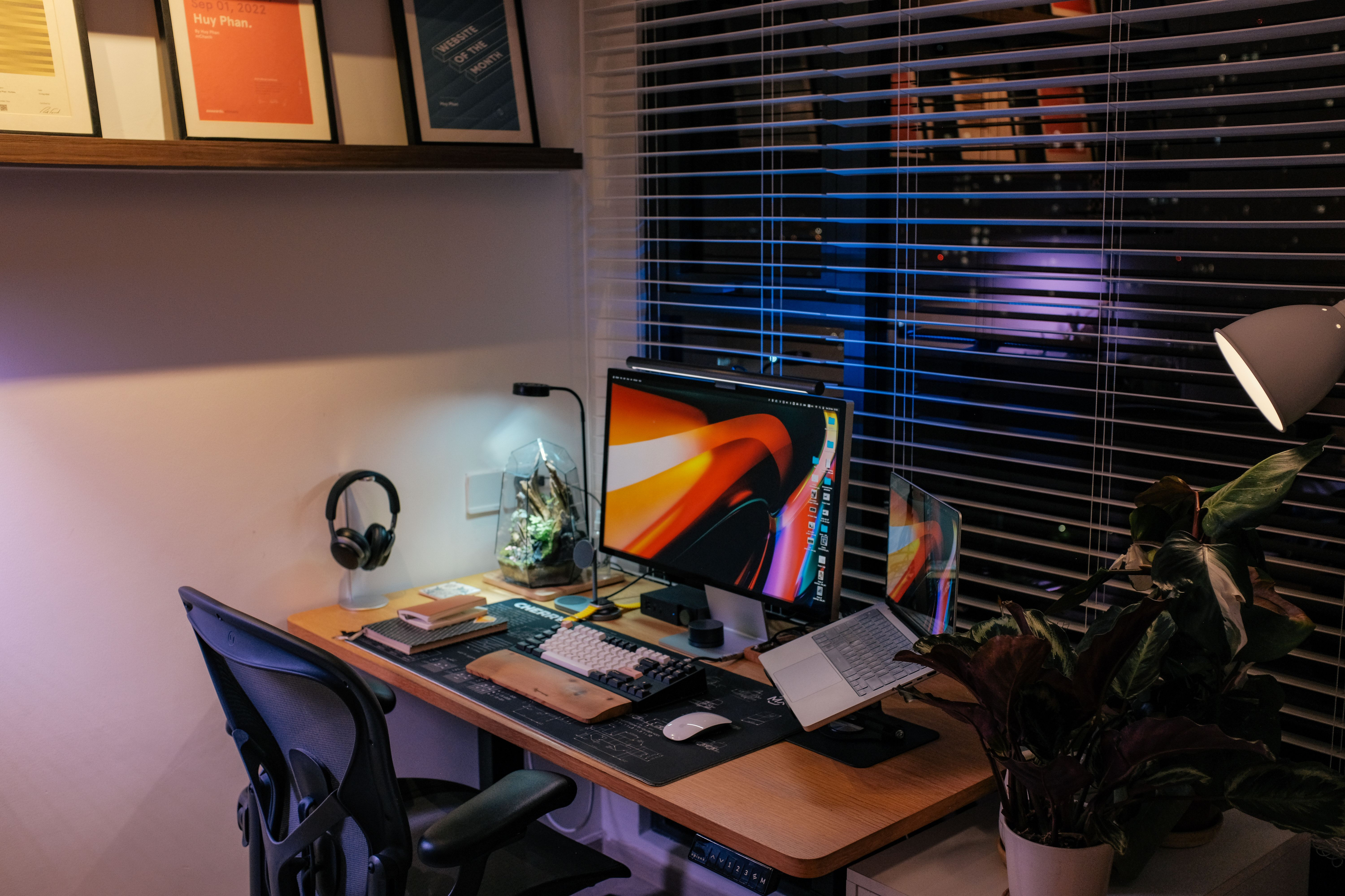
Placement can make or break the setup. Face a window for daylight, but keep it to your side, not behind you, or you'll turn into a silhouette on every call. Angle the desk so your bed sits outside the camera frame. Then build upward: a shelf or two above your studio apartment desk keeps cables, notebooks, a lamp, and a plant within reach without stealing surface space.
Some days one room isn't enough. A back-to-back call schedule or a neighbor's midday construction can blow up your focus, and that's when a change of scenery earns its keep. Compass Flats residents can step into the on-site coworking space when the studio feels tight, then head back home to unplug. A quiet lobby or a nearby café works the same way. Booking a focused hour elsewhere can reset a stalled afternoon faster than grinding away at a cluttered desk.
The hard part of working from home in a studio apartment is stopping. Boundaries keep the job from swallowing the apartment. Set a start time and a stop time, and mean them. When you're done, close the laptop, tuck loose papers into a drawer, wheel the chair away, and physically leave the work zone. That tiny ritual is your commute home. If work creeps into the evening, unplugging the monitor is a clear signal the day is closed.
What's the Best Small Desk for a Studio Apartment?
The best small desk for a studio apartment is one you can make disappear. Fold-down wall desks, slim writing desks, corner units, and compact standing desks all buy back floor space when the day ends. Match the desk to your job and your layout, not to a photo you liked online.
Not every desk suits every renter. Here's how the common options stack up for a small space, from the no-buy fallback to the biggest space-saver.
| Desk type | Best for | Footprint | Watch out for |
|---|---|---|---|
| Dining table (double duty) | No-buy option, occasional work-from-home days | No extra space needed | Blurs meal and work lines; clear it daily |
| Slim writing desk | Laptop-only, lighter tasks | Small, always out | Not enough surface for dual monitors |
| Compact standing desk | Long, call-heavy days and better posture | Moderate | Costs more; confirm it fits when raised |
| Fold-down wall desk | Tightest studios, true dual use | Near zero when folded up | Needs a sturdy wall; renters may need approval to mount |
Whatever studio apartment desk you land on, measure twice. Tape the footprint onto the floor before buying, leave room for the chair to roll back, mind the door swing, and keep a clear path out. A cramped home office studio you dread sitting at simply won't get used, and the whole plan falls apart.
Frequently Asked Questions
1. Do apartments come with work desks?
Usually not. Most U.S. apartments rent unfurnished, so a desk is on you unless you sign for a furnished or short-term unit. Some communities close the gap with shared workspaces or a business center, which is worth checking during your search if a home office matters.
2. Is a 1-bedroom apartment with office space better than a studio?
It depends on your job. If you take calls all day or need a door you can shut, a 1 bedroom apartment with office space gives real separation, and even a one-bedroom you can zone into a nook beats an open studio for that. For quieter, laptop-based work, a well-planned studio holds up just fine and costs less.
3. What are the essentials for studio apartment living when you work from home?
Keep the list short and the space usable. The core kit:
- A dedicated desk and a supportive chair
- Solid internet, wired for important calls
- Task and natural light, glare-free
- Noise-canceling headphones
- Vertical storage to keep surfaces clear
- A way to hide work at day's end
4. How do you take video calls in a studio apartment?
Set yourself up to look and sound put-together. Face a clean wall or a window so the light hits your face, not your back, and angle the bed out of frame. Wear headphones with a built-in mic, and give housemates or pets a heads-up before the call starts.
5. How do you keep work and life separate in a studio apartment?
Lean on time and place. Set firm start and stop hours, and when you finish, cover the desk and move to a different zone to unwind. Stashing the laptop out of sight is the simplest commute home you'll ever have.
The Bottom Line on Small-Space Remote Work
Working from home in a studio apartment rewards planning over square footage. Claim a zone, choose a desk that folds out of the way, light it properly, and guard the line between work and rest. Compass Flats gives you a running start with flexible layouts and shared workspace for the days one room isn't enough, right here in New Braunfels. Want to see how it lays out? Take a virtual tour and picture your corner.